-1792510340682.png)
I like a good cheeseburger.
Big patty between sesame buns. Cheese. Onions. Lettuce. Ketchup and mustard. Pickles. Probably bacon, too.
Have you ever walked into a new-to-you restaurant, hungry for something in particular, only to be met with a seemingly endless list of options? All you want is a great-tasting cheeseburger, but now you have to decide between a dozen potentially really good choices!
And that's when the questions start.
Which one is best? What's the difference? Am I going to regret my choice?
At least you know what you want.
In the case of financial goals and strategies, the outcome you're trying to achieve may not be so clear. And then there are so many options to choose from... IRAs, 401(k)s, brokerage accounts, 529 plans, money markets...the list goes on and on!
The cognitive load of making a decision about your finances, let alone understanding all the options, can be crippling.
If only it were as easy as choosing the best cheeseburger.
Understanding Creates Confidence
Think about the last time you had to make an important decision: How much more confident did you feel once you understood your options?
When we, as consumers, can clearly understand the tradeoffs—what we stand to gain, what we might give up, and what happens next—making a decision becomes a whole lot easier.
The same is true with financial decisions.
And that's why it's important for us, as advisors in your financial journey, to take our communication skills seriously.
To speak more clearly.
To communicate our thoughts more succinctly.
To find better ways to explain complex ideas more simply.
Because having the right answer doesn't do much good if the person we're helping doesn't understand it well enough to act.
The Whiteboard Moment
One of the most fun occurrences in our client meetings is when someone asks if they can take a picture of our whiteboard.
The whiteboard has become a key piece of our meetings. We began including it as a core communication standard in our practice within the last few years. And every time we use it to explain a client's financial story, a strategy, or potential outcomes, it's fun for us to watch a new client's face as they finally get it.
That moment when something that previously seemed complicated starts to make sense. They understand what's going on, what they could potentially accomplish, and what it could mean for their family. They want to remember how the topic was explained, so they take a photograph. But I think there's something more meaningful happening. They're capturing a moment of clarity.
We've even heard clients say something to the effect of, "I can't wait to show this to my kids or grandkids!"
I could swear these clients walk out of our office a couple inches taller.
And that's pretty rewarding.
Simple Doesn't Mean Easy
There's an important distinction here.
Financial decisions aren't always simple. There can be complicated tax consequences, investment considerations, risks, and tradeoffs that need to be understood.
Our job isn't to pretend those complexities don't exist.
It's to do the difficult work of understanding them well enough that we can explain what matters in a way that makes sense.
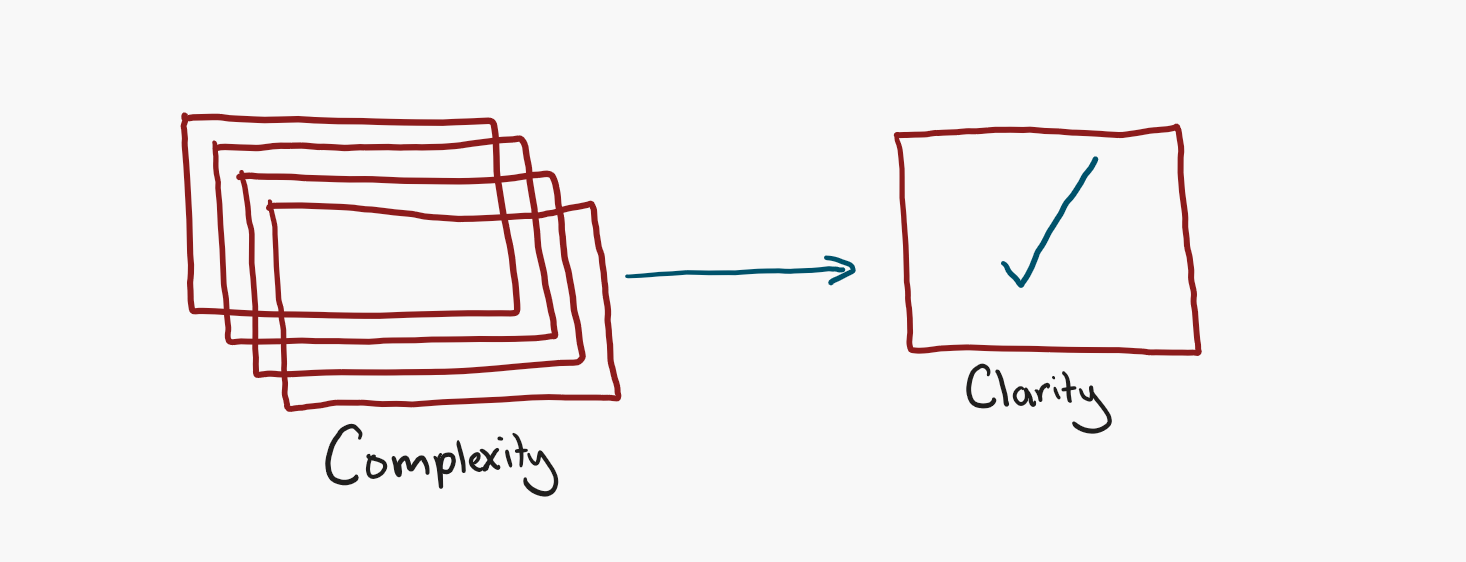
Simplifying the explanation shouldn't mean oversimplifying the decision.
That's a responsibility we take seriously.
We hope all advisors take on their role as communicators more seriously, too. The people we serve need us to communicate better.
Our advisory team is always on the lookout for better ways to explain ideas, illustrate tradeoffs, and help clients understand their choices. We consider it a failure on our part when we haven't communicated something clearly enough and, as a result, progress toward a client's goals stalls. Because the purpose of our expertise isn't simply to know more.
It's to help the people we serve understand more.
And when people understand their options, they're often more confident in the decisions they make.
That's why simplicity matters.
Besides, if our goal is a juicy cheeseburger, wouldn't it be nice to spend less time staring at the menu and more time enjoying that first bite?