-1793635505994.png)
What did you have on your BINGO card for 2026?
Maybe it was getting that promotion, going on that vacation-of-a-lifetime, or seeing that grandbaby for the first time. All great things, and I certainly hope they happened!
But what about the things you never would have wanted on that card?
Losing a loved one to cancer. A car accident. Or receiving that phone call you wish had never come.
Life throws curveballs. Some we think might happen, but others we couldn't even fathom.
If we could look into a magical crystal ball and predict the future, planning would be easy. We could prepare for every challenge, take advantage of every opportunity, and maybe even avoid some of the difficult decisions along the way.
If only, right?
"What Would You Do?"
We often get asked this question when meeting with our clients.
And we appreciate it as a sign of trust. They genuinely want to know what we would do if we were in their shoes.
But the answer isn't always so straightforward.
Even when we do our best to understand our clients' financial lives—not just what's going on today, but the decisions they've made in the past, the ones they'd make again, the ones they wish they hadn't, and the life experiences that shaped them—we still can't know exactly what the future holds.
And sometimes, we can't know which tradeoffs will ultimately matter most to them.
Not because someone made a mistake in the planning process.
But because life changes.
A decision that makes perfect sense today might look different five years from now. Priorities shift. Opportunities appear. Challenges arise. And sometimes, an experience changes the way we think about everything.
So when someone asks us, "What would you do?" our responsibility isn't simply to give them an answer based on what we'd choose for ourselves.
It's to help them understand their options, consider the tradeoffs, and make a thoughtful decision based on what matters most to them today.
While recognizing that tomorrow may look different.
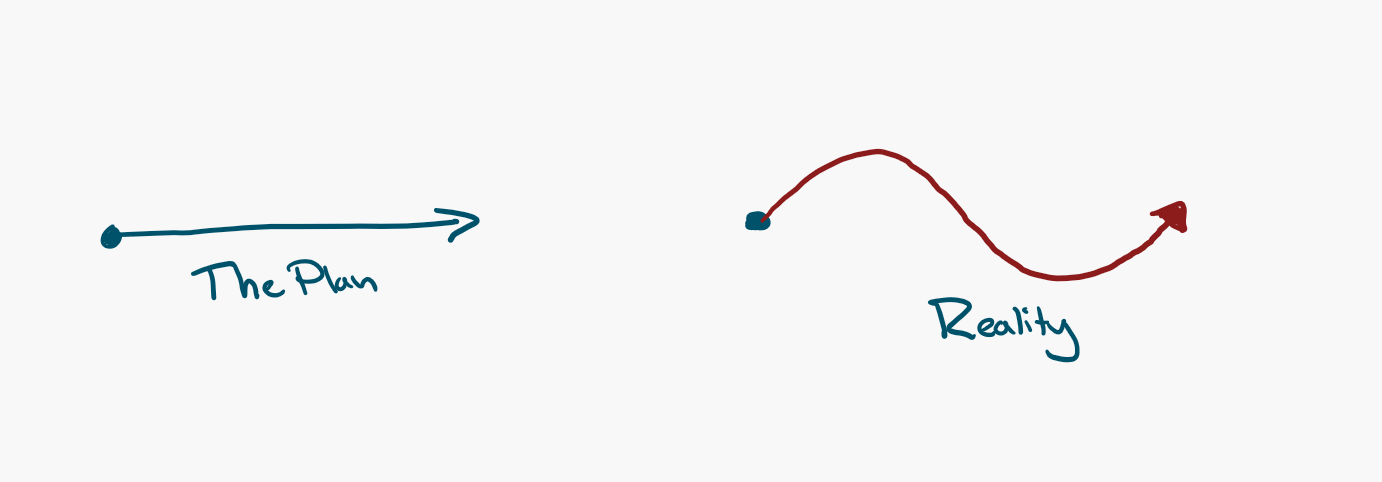
The Plan Needs to Be Flexible
Or better yet, we need to be flexible.
Because we need to be ready to pivot when life changes.
Change is one of those certainties in life.
A stress-tested financial plan is valuable. We can model different market environments, changes in income, unexpected expenses, and plenty of other possibilities.
But even the most sophisticated financial plan can't predict the future.
And perhaps it shouldn't have to.
The value of a financial plan isn't that every assumption turns out to be correct or that every decision we make today remains the right one forever.
It's that we have a clearer understanding of where we're headed, what matters most, and how the decisions we're making can help us get there.
And when life changes, we revisit those decisions.
We adjust. We reconsider. Sometimes we change direction entirely.
A changing financial plan isn't necessarily a sign that the original plan failed. It may be a sign that the plan is doing exactly what it's supposed to do—evolving with your life.
A Life Well Lived
Ultimately, I don't think the best financial outcome is simply the one that looks the most impressive on paper.
Nor is it the one where everything unfolded exactly as we originally planned.
Because life rarely works that way.
The best outcome is one where we've made thoughtful decisions with the information we had, adapted when circumstances changed, and continued using our resources toward the things that mattered most.
And hopefully, when we look back someday, we won't be measuring success by how closely life followed our original financial plan.
We'll be able to say:
"That was a life well lived."